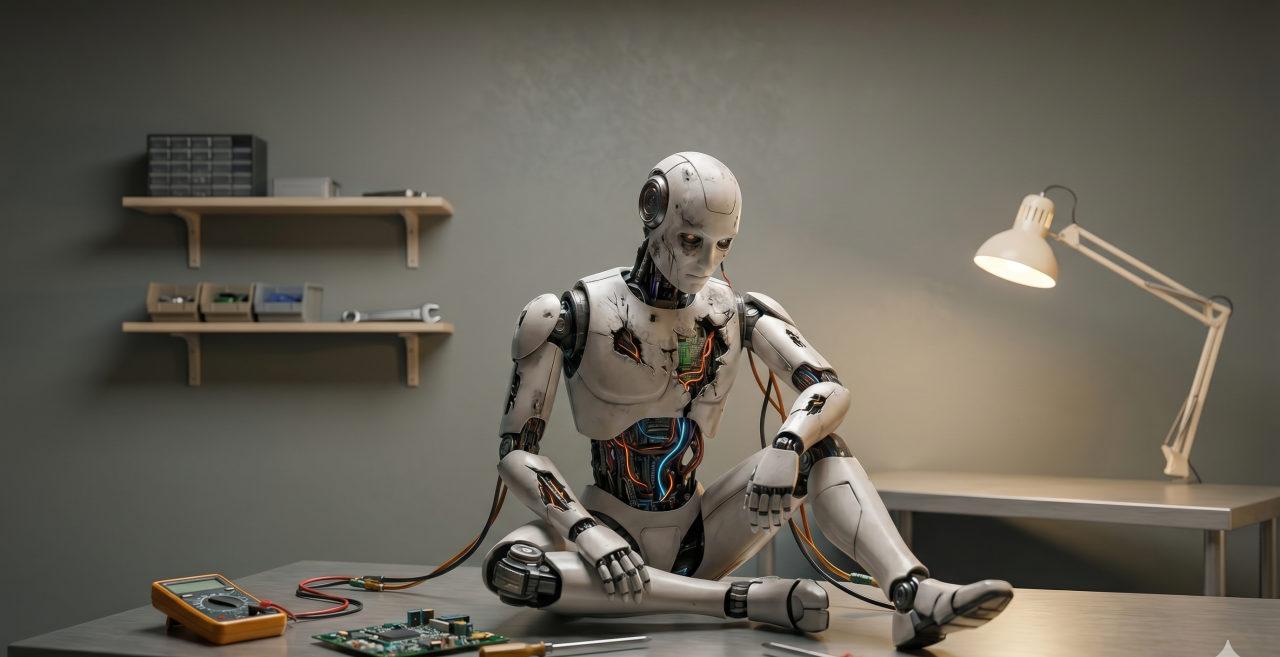

Ask a model to summarize three years of a borrower's financial statements and it is done in seconds. Ask it which of those numbers your credit committee will worry about and it has no idea. That is the shape of the machine. Enormous processing, and none of the context that tells it what matters here. The reflex across the industry is to treat that blank space as a temporary defect, a thing the next release will fill. It will not fill itself. The asymmetry is structural, it is the source of most of what is hard about applied AI, and once you stop waiting for it to disappear you can start building as though it never will.
Spend a day with a capable model and you stop being impressed by the speed. You start noticing the forgetting. It reads a contract in a blink and misses the one clause the deal actually turns on, because nobody told it which clause mattered to you. It writes flawless code against the wrong assumption. It is brilliant inside the four corners of the prompt and lost the moment the real answer depends on something outside them. The power is real. So is the blank space behind it.
People are the mirror image. We hold a lifetime of context, the unspoken rules of a room, the way our best colleague would handle a tricky call. We know which client never wants to be called after a bad quarter, which number in the report the board will actually fixate on, when a polite request is really a hard deadline. None of that lives in a document. It lives in the person, accumulated over years, mostly below the level of words. And yet we reason slowly. We tire. We can hold only a few things in mind at once, and by Friday we have forgotten half of Monday.
Set the two side by side and the asymmetry is almost comic. The machine has the horsepower and none of the map. The expert has the map and a fraction of the horsepower. Each is strongest exactly where the other is weakest. That is not a coincidence to be smoothed over. It is the single most important fact about working with these systems, and almost everything else follows from it.
The optimistic reading is that this is a phase. The machine's memory is thin today, the argument goes, but the field is closing the gap on every front. Context windows that once held a few pages now swallow whole books. Retrieval systems pull the right document in at the right moment. Fine-tuning bends a general model toward a particular domain. Persistent memory lets a system carry notes from one session into the next, and continual learning promises models that keep updating after they ship. Each of these is real and useful. None of them touches the actual problem, and seeing why is the whole point.
Every one of those advances enlarges what the machine can store or how far back it can reach. The problem was never storage. A model that can ingest a thousand pages does not thereby know which paragraph is load-bearing for the decision in front of it. A retrieval system fetches what is similar to the question, not what a seasoned hand would have known to look for. Fine-tuning shifts the average of the model's behavior, it does not install the specific judgment that tells it when the average is exactly wrong. Give a system more memory and you have given it a larger library with no librarian, a vast and even field of recall in which nothing is marked as the thing that matters here, now, in this case. The expert's gift is not that they remember more. It is that they remember almost nothing and it is the right almost nothing.
Watch how this plays out in a single afternoon. A credit analyst is working a mid-market loan file. The model can recite every covenant, summarize three years of statements, and surface every comparable deal in the book, all in seconds. What it does not do is pause on the one customer that accounts for most of the borrower's receivables, because no figure on the page flags that as fragile. The analyst pauses there instantly. She has seen a business like this one fail, and the memory she draws on is not the whole history, it is a single compressed lesson that fires at exactly the right moment. The machine had more of the file in view than she ever could. She had the one thing that decided the answer.
Once you see this, the failures of applied AI stop looking like a list of unrelated bugs and start looking like one problem wearing different costumes. The model that confidently invents a citation is doing what a mind with vast fluency and no grounding does. The assistant that gives a technically correct answer no human would ever actually give never had the context that would have told it what correct means here. The agent that takes ten reasonable steps and one catastrophic eleventh is missing the quiet rule every person in the building knows and nobody wrote down. Trace each failure back far enough and you arrive at the same place. The machine is acting without the context a person would have brought, because that context was never transmitted, and no amount of additional recall supplies it on its own.
This reframes what the work actually is. The instinct, when a model disappoints, is to reach for a bigger model, or failing that, a longer window and a better retriever. Sometimes those help at the margin. But raw capability and raw recall were rarely the thing missing. The thing missing was the part of the expert that never made it into the prompt. You can pour more horsepower into a car with no map and you mostly arrive at the wrong place faster. The real leverage is not in adding intelligence or memory to the machine. It is in moving the right intelligence from the person to the machine.
That turns out to be hard for a reason worth naming. Most of what an expert knows, they cannot fully say. A seasoned analyst will tell you they just have a feel for when a story does not add up, and they are not being evasive. The feel is real and the words for it are genuinely absent. Their knowledge lives as pattern and instinct, compressed by years of practice into something faster than explanation. Ask them to write the manual and you get a thin, tidy document that leaves out the very judgment that made them worth asking. The hardest knowledge to transmit is precisely the knowledge that matters most, because it was never stored as language in the first place.
So the craft is not transcription. You do not sit the expert down and ask them to dictate their brain. You reconstruct how they think. You watch the calls they make and, more revealing, the calls they decline. You find the cases where two reasonable people would diverge and you pin down which way this expert goes and why. You surface the assumptions so automatic they had become invisible. The aim is to turn a feel into something explicit enough that a capable model can carry it, the layers of reasoning and the small, hard rules that govern how a particular expert moves through a particular world. Done well, the model stops behaving like a brilliant stranger and starts behaving like the person whose judgment you trusted in the first place.
It helps to be precise about what is being transmitted, because it is not raw information. The machine is already drowning in information, and every advance in memory pours in more. What it lacks is structured judgment. Think of the difference between a thousand pages of policy and the three lines a veteran uses to decide in practice. The information is cheap and public. The compression is the expertise, and the compression is what lives in the person and almost never on the page.
This matters more, not less, as the systems grow up. A chatbot that gives a weak answer wastes a minute of your time. An agent acting on your behalf, moving money, sending the message, taking the step, fails in a different register entirely. As models gain the ability to act in the world, the cost of missing context climbs from embarrassing to serious. A capable agent with no sense of the unwritten rules is a fast, tireless actor with no judgment about which lines must never be crossed. The more able these systems become, the more the unspoken human context becomes the thing standing between useful and dangerous.
Will better memory close the gap? Memory will keep improving, and it should. But a model that can recall everything still has to be told what matters in your context, and that instruction does not ship with the model. Its lack of permanent, idiosyncratic memory is also partly a feature: it is what lets the model stay general, fast and the same for everyone. We do not actually want to hand it a human lifetime of accumulated context and hope it absorbs the relevant parts, because that simply reproduces the analyst's full library without the analyst's instinct for which shelf to walk to. We want to give it the distilled, deliberate version, the compact rules and the encoded judgment that say, in this context, here is how to think. The two kinds of intelligence are specialized in different directions, and the work of joining them is not a stopgap waiting on a better model. It is the central work, and someone has to do it on purpose.
Notice what happens when that work is done well. The expert is no longer the bottleneck. Their judgment runs at machine speed, across far more cases than they could ever touch by hand, at three in the morning, without tiring, without forgetting Monday by Friday. The machine is no longer a brilliant stranger, it acts the way your best person would act, because the way your best person thinks has been transmitted into it. The person supplies the context and the judgment. The machine supplies the speed and the reach. The reason this pairing holds and will keep holding is the same reason the asymmetry never closes. Neither side is drifting toward the other. The value is in the bridge, and the bridge is the thing that has to be built rather than waited for.
The examples in this essay are illustrative composites. They do not describe a client engagement and are not professional advice.