
You know, without thinking, how a dog reacts when a stranger approaches, when a door opens, when its bowl sits empty. The ears, the posture, the pause before the bark. None of that is written down anywhere. It is context you carry and never narrate, a thousand small expectations resting below the surface of your attention. You did not study it. You absorbed it, the way you absorbed which side of the sidewalk to walk on and how close to stand to a person you have just met.
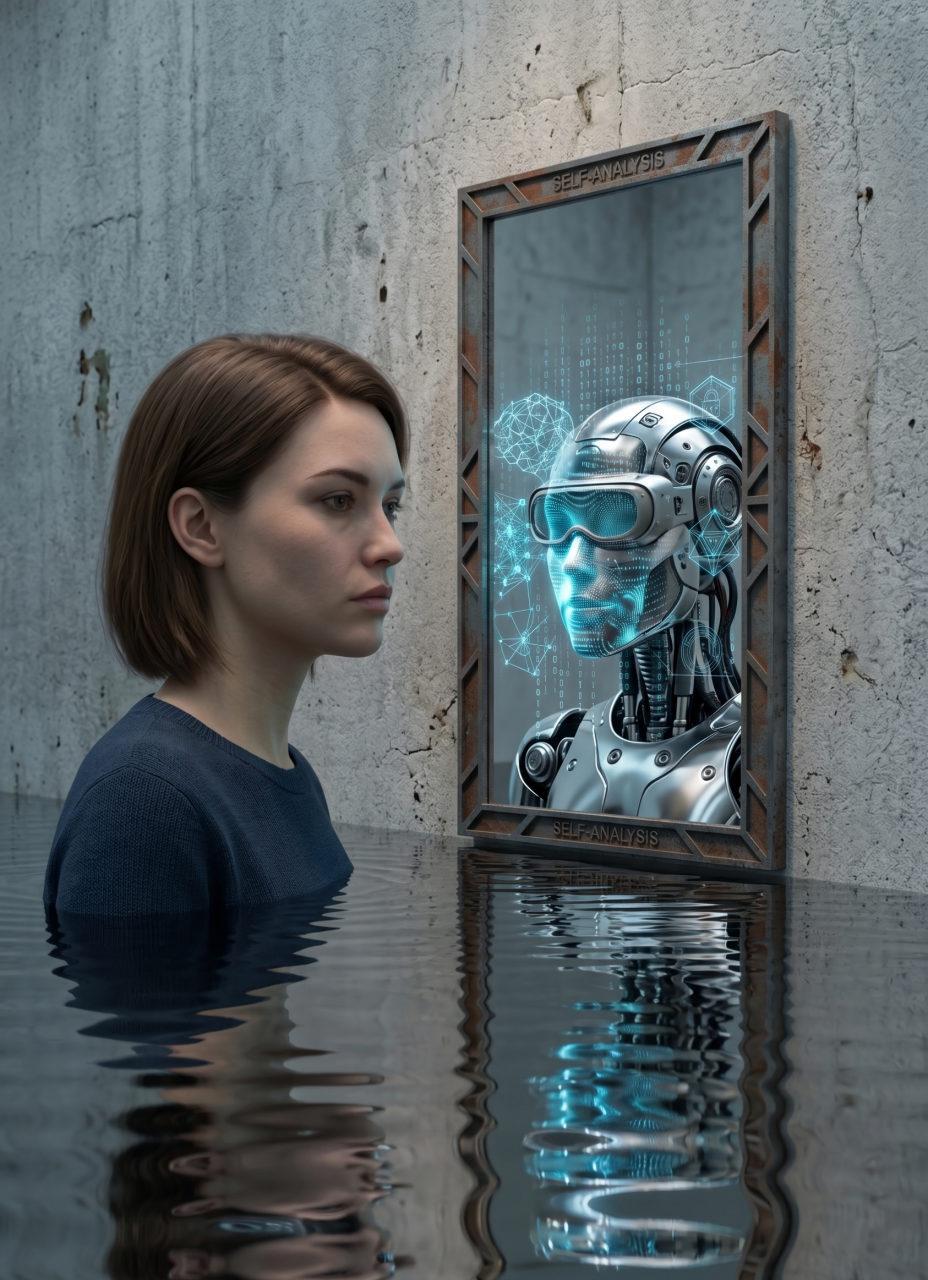
Now try to give that knowledge to a robot in the same house. Not a science fiction android, just a capable home assistant a few years from now, with arms and wheels and good enough vision. The moment you sit down to tell it that the dog by the door is excited and the dog under the table is afraid, something odd happens to you, not to the machine. You discover you cannot quite say how you know. You reach for the rule and find an instinct where the rule should be. The robot's blank stare turns out to be a mirror, and what it reflects is the enormous amount you understand and have never once put into words.
That reflection is the real subject here, and it is more useful than it first appears. The dominant story about embodied AI is a story about the machine, its hands, its balance, its vision, the model behind its eyes. The more revealing story is about the person standing in front of it, forced for the first time to articulate a competence that has always run silently. The robot does not mainly expose a limit in the technology. It exposes how much of human expertise was never knowledge in any sayable form, only practice worn smooth by repetition. The machine is the instrument that makes that practice audible.
Watch what happens the moment you actually try. Why do you knock before opening a closed bedroom door? You start to answer and notice the answer has three conditions folded into it, whose room, what time, whether the door was closed on purpose or by a draft. Why did you reach for the frightened dog more slowly than the excited one? Because a lowered head and a still body mean something, and you have read that sentence ten thousand times without ever seeing the letters. Each question you ask on the robot's behalf pulls one of these reflexes up into daylight, and almost every one turns out to be denser than you expected, a small structure of judgment you had compressed into a single unconscious move. The work of teaching the machine is, first, the work of decompressing yourself.
This is why the task resists the obvious shortcut. The instinct, when a machine falls short in a home, is to want a stronger model behind its eyes. A stronger model is a more capable actor, and capability was rarely the thing missing. What is missing is the rule no one ever stated, and no degree of raw ability lets a system infer a rule from a context it has no way of knowing it is standing inside. It cannot deduce that this house has a child frightened of loud noises, or that the grandmother who visits on Sundays does not like to be approached from behind. These are not facts in any training corpus. They are local truths, and a home is built almost entirely out of local truths. You do not reach them by thinking harder. You reach them only because someone who lives there finally said them.
The cost of skipping that step is not dramatic failure but a steady, grinding wrongness. Picture a machine that is flawless on every line of its spec. It navigates without touching a wall, grasps the cup without crushing it, answers the instant it is spoken to. By the family's standard it can still be a poor guest within the hour. It rolls its cheerful self into the middle of a hard conversation. It hears bring me a drink and treats breakfast and a dinner party as the same instruction. Nothing it does is technically incorrect. It is simply wrong in the room, and a thing that is wrong in the room is not a helper. It is an expensive source of small daily friction, correct in every action and deaf to the situation each action lands in.
The friction sharpens, not softens, as these systems grow a personality, which is plainly where they are heading. People will not welcome a faceless appliance gliding through the space where they live. They will want a manner, a warmth, some sense that the thing has a grasp of who they are. But personality is exactly where unstated context turns unforgiving. The same proactive helpfulness that delights when it clears the table betrays the household when it files away the papers someone spread out on purpose, mid-project, meaning to return. The charm and the failure pour from one source, a confident actor moving through situations whose rules it was never handed. Warmth without context is not warmth. It is the appearance of it, applied at the wrong moment.
So the question worth taking seriously is not whether a home robot can be made smart enough. It is narrower and harder. Of the vast unwritten knowledge a household assumes, how does the right fragment reach the machine at the precise instant it must behave well, and not as a flood of irrelevant detail it cannot use? A home holds more tacit rules than any system could carry in mind at once, and most of them are silent in any given moment. The kitchen rule is dormant in the nursery. The funeral rule never fires at a birthday. A machine drowning in every rule it might ever need is no better off than one with none, because it cannot tell, in the moment a child starts to cry, which sliver of all that knowledge now governs what it should do.
This is the selection problem, and it is where the real engineering lives. The aim cannot be to pour an entire household's customs into a system and trust it to retrieve the apt one under pressure. It is to bind a small number of compact behavioral laws to the situations that actually summon them, so that the rule about moving slowly near the very young surfaces when the very young are present and stays quiet otherwise. A behavioral law of this kind is not a long instruction. It is a dense, load-bearing statement of conduct, a few words that carry the weight of a context no one spelled out. Move slowly near the very young and the very old. When a person turns their body away, give them room. When something breaks, stop and signal before acting. The difficulty is less in writing such a law than in arranging for it to arrive on cue, neither early as noise nor late as regret. A handful of these, well chosen and well timed, does more to make a machine fit to live with than a large jump in raw intelligence.
And here the mirror returns, because each of those laws can only come from a person who has been made to notice their own behavior. The household is the sole author of its own local truths. No external dataset contains the fact that the mug on the windowsill is not trash but someone's, that it has sat there for weeks on purpose and must not be tidied. Only the people who live with that mug can say so, and saying so requires them to register, perhaps for the first time, that they have been quietly enforcing a rule about it all along. The machine cannot be told what no one has yet thought to think. The act of teaching it is therefore an act of self-examination, conducted by the household, with the robot as the patient occasion for it.
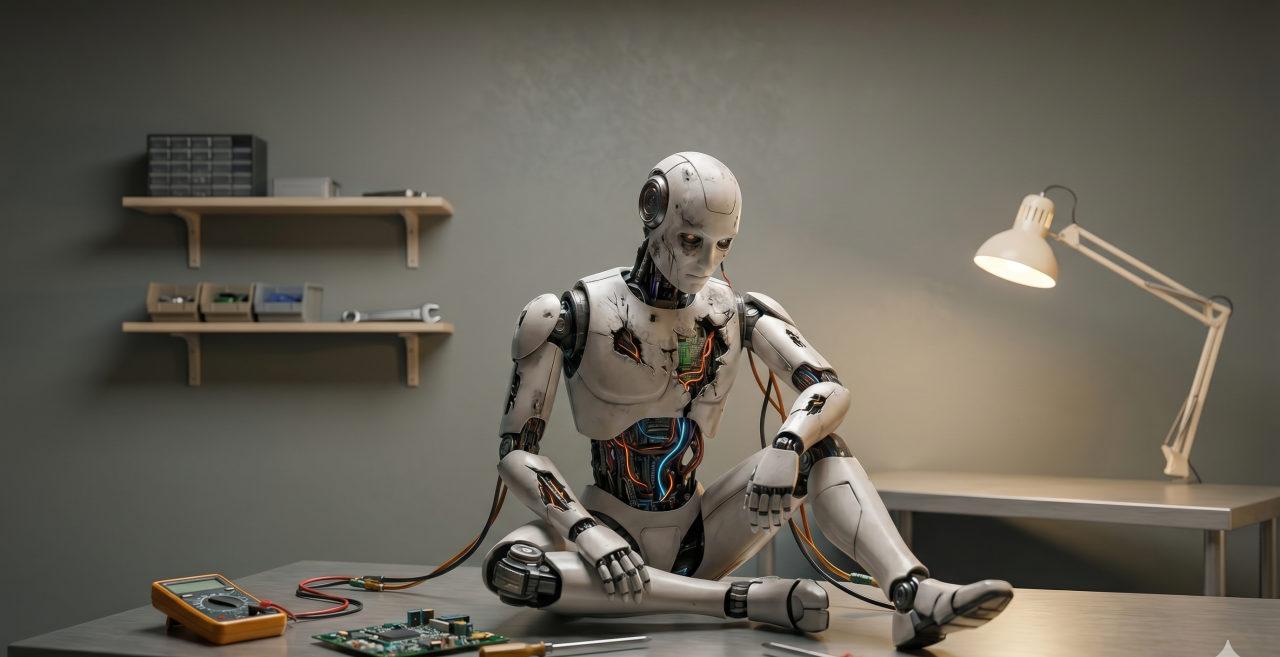
That inverts where the difficulty actually sits. The headline difficulty is hardware, better hands, better balance, steadier vision. Those problems are real and they are being solved on a steep curve. The quieter difficulty does not yield to that curve at all, because it is not the machine's to solve. It is ours. It is the labor of converting a lifetime of unspoken practice into statements plain enough to hand over, and that labor falls on the people who hold the practice and have never had reason to examine it. The bottleneck is not the body or the model behind the eyes. It is the translation of tacit human competence into something explicit enough to transmit, and only a human can perform that translation.
Which is why the firms that succeed at putting machines into homes will not be distinguished by the size of their models. They will be the ones who treat the naming of the obvious as the central work rather than an afterthought, who sit with a household and draw out, one behavioral law at a time, the rules it has always obeyed without speaking. The competence is already there, complete, in the person. It has simply never been said. The work is to say it, precisely enough that a capable machine can finally act on it, and to deliver each law to the moment that needs it. Do that, and the robot stops being a stranger improvising from a stranger's priors. It begins to move through the house the way someone who lives there would, because someone who lives there finally put into words what they had always known.
The examples in this essay are illustrative composites. They do not describe a client engagement and are not professional advice.